Connected Africa Summit 2026: The Summit That Told Itself the Truth
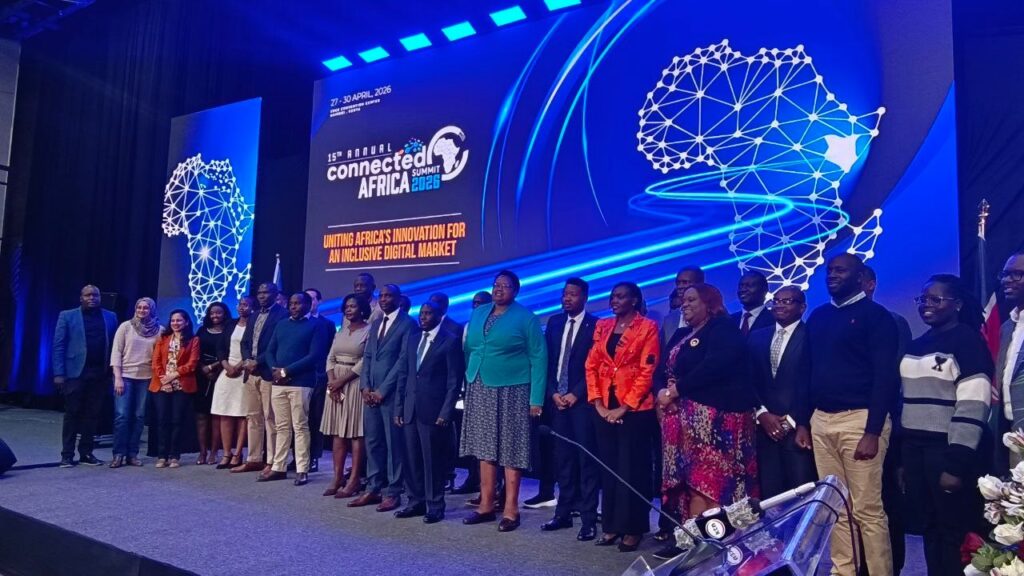
For a head of state-level address, that is leadership worth paying attention to.
Safaricom's Chief Enterprise Business Officer Frankline Okata arrived with a concrete example rather than a principle: "Across Africa, the conversation is shifting from ideas to execution, from pilots to scale, and from isolated systems to integrated digital ecosystems that create measurable impact. Our collaboration with ICT Authority demonstrates what is possible when public and private sector players work together to accelerate national digitisation." Huawei Kenya's Policy and Partnerships Lead Adam Lane named the constraint that infrastructure investment alone does not fix: "Africa's digital transformation must be powered not only by technology, but by skilled people who can build, manage and innovate with it." Kenya has laid 30,000 kilometres of new fibre towards a target of 100,000. Tanzania, Rwanda and others are accelerating their own backbone programmes.
The summit's agenda had a thread running through it that did not always get named directly but was present in almost every session: the growing role of outsourced services in delivering Africa's digital ambitions at scale. Cybersecurity was day one's headline topic, and the conversation kept returning to outsourced Security Operations Centres as a practical route for governments and enterprises that cannot build that capability in-house. AI-powered contact centres, data annotation, content moderation, and KYC verification all featured as live service lines rather than future possibilities. The multilingual dimension came up repeatedly: a continent with accelerating fintech adoption and deeply diverse language populations needs customer support infrastructure that reflects that reality.
The talent story is no longer a projection. Africa has a young, technically literate workforce already delivering BPO and ITO services to clients in Europe, the Americas, and the Gulf, competing on quality, time zone proximity, and language range. What harmonised frameworks and a functioning Secretariat mean for BPO and ITO operators specifically is this: a single regulatory environment across borders makes it possible to build delivery operations that serve multiple African markets from one location, without rebuilding compliance architecture from scratch for each jurisdiction. That is not a marginal efficiency. For operators with the seats, the certifications, and the language capacity already in place, it is the difference between a regional opportunity and a continental one.
The summit has now put measurability at the centre of the agenda, and that gives CAS2027 a clear opportunity: to return not only with fresh commitments, but with evidence of progress. By the time delegates reconvene, the strongest signal will be whether this year’s ambition has translated into practical coordination, implemented trade frameworks, and visible tracking of Africa’s AI opportunity. Has the Secretariat moved from guidance to working protocols? Have the AfCFTA Digital Trade Protocol annexes advanced from policy commitment into real-world application? And has the $65 billion AI opportunity begun to be measured against a credible baseline? These are the questions that can turn the summit from a platform for alignment into a real mechanism for delivery.
World Bank Country Director Qimiao Fan ’s call for policy harmonisation and deeper investment in digital skills brought the summit back to its central point: Africa’s digital future will depend on whether infrastructure, regulation, talent and services can advance together. CAS2026 showed that many of those pieces are already moving. Fibre networks are expanding, AI experimentation is accelerating, public-private partnerships are becoming more practical, and digital service capacity is maturing across the continent.
The significance of the Connected Africa Secretariat is that it gives this momentum a place to be coordinated beyond the summit itself. By CAS2027, the measure of progress should be visible not only in new commitments, but in clearer cross-border rules, stronger institutional coordination, better-aligned investment, deeper skills pipelines and more scalable service capacity. That is the real promise of CAS2026: a shift from continental ambition to the disciplined work of making Africa’s digital economy easier to build, govern and scale.
If you’d like to continue the conversation or explore what this shift might mean for your organisation, our team is always open to connecting - click through to CEO George Jabesh or EU Marketing Director Chris Hague .